[ Journal · The Material ]
What is beef tallow? Definition, composition and uses
The word “suif” (tallow) comes from the Latin sebum. It is exactly the same word as “sebum,” which describes the oily film your skin produces itself. French has inherited the same Latin term twice, and no one notices it anymore. Here is what beef tallow actually is, what it is composed of, and why this coincidence of vocabulary is not entirely a coincidence.

What is beef tallow, exactly
In short: beef tallow is beef fat that has been melted down and then filtered to remove anything that is not fat. What remains is a pure fatty substance, solid at room temperature.
Before melting, this fat goes by another name: it is raw fat, and the most sought-after is kidney fat, which surrounds the kidneys. It is denser, whiter, and more neutral than the subcutaneous fat found under the skin.
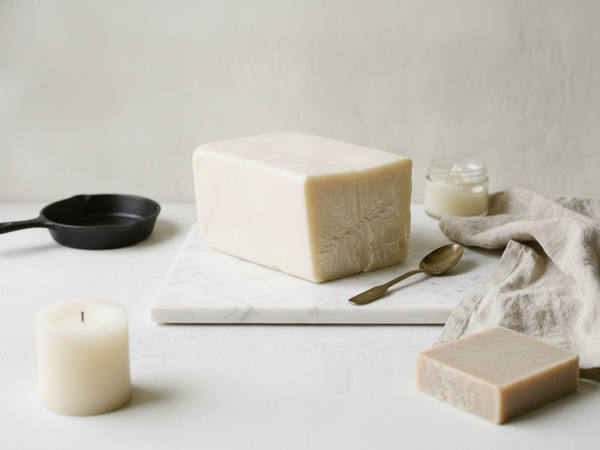
After melting and filtering, we get tallow. It appears as an off-white to ivory block, firm to the touch, with a texture similar to butter taken out of the refrigerator. When properly purified, it has almost no scent.
Tallow and sebum are the same word
This is the kind of detail you discover when opening an etymological dictionary, and it changes the way you look at the material.
“Suif” comes from the Latin sebum.[1] The word has traveled through the centuries via common usage: sebum became seu in Old French, then sieu, then sui, and the final f only appeared in the 13th century. In Normandy, people still used to say sieu.
“Sébum” also comes from the Latin sebum. But via a different route: that of scholarly borrowing, much later, when medicine needed a word to describe the skin's oily secretion. It went to get it directly from Latin, without going through popular usage.
Should we conclude that our ancestors understood the relationship between animal fat and skin fat? No, and it would be dishonest to claim so. The Latin sebum simply meant “fat,” without distinguishing the origin. The coincidence is linguistic rather than biological.
But it becomes unsettling when you look at the figures in the following section.
Tallow, kidney fat, lard, beef suet
French makes finer distinctions than English, and these words are not interchangeable.
| Word | What it is | Animal | State |
|---|---|---|---|
| Suif (Tallow) | Rendered and filtered fat | Beef or sheep | Rendered |
| Gras de rognon (Kidney fat) | The fat around the kidneys, the finest | Beef | Raw |
| Gras de couverture (Subcutaneous fat) | Fat under the skin, more flavorful | Beef | Raw |
| Blanc de bœuf (Beef suet/fat) | Refined tallow sold in blocks for frying | Beef | Rendered |
| Saindoux (Lard) | The equivalent of tallow, but for pork | Pork | Rendered |
| Graisse de canard (Duck fat) | The poultry counterpart | Duck, goose | Rendered |
The most frequent confusion concerns lard. One sometimes reads “pork tallow”: the expression makes no sense. Tallow is bovine or ovine, lard is porcine. If the subject interests you, we compare occlusive fatty substances in our article beef tallow vs. petroleum jelly.
And if you are specifically looking for where to source it, that is the subject of our guide where to find beef fat.
What is tallow made of
In short: almost exclusively fatty acids. Three of them account for over 85% of the total, and they are the same three that dominate human sebum.
| Fatty acid | In beef tallow | In human sebum |
|---|---|---|
| Oleic (C18:1) | 36 to 43% | 15 to 20% |
| Palmitic (C16:0) | 26 to 28% | ≈ 25% |
| Stearic (C18:0) | 18 to 22% | low |
| Linoleic (C18:2) | less than 8% | variable |
| Sapiens (C16:1) | absent | ≈ 25% |
The correspondence regarding palmitic acid is striking: about a quarter of the material in both cases.[2] This is what forms the idea of biomimetics, and what explains why tallow behaves differently from a vegetable oil on the skin.
But look at the last row, because it is the most honest part of the table. Human sebum contains about 25% sapienic acid, a fatty acid not found in any other animal species or plant. Tallow does not contain a trace of it. We are therefore talking about resemblance, never identity, and anyone who writes that tallow is “identical to sebum” is mistaken or misleading you.
Tallow, however, provides four fat-soluble vitamins—A, D, E, and K—in varying amounts depending on the animal's diet. The details are in our article on the benefits of beef tallow for the skin.
How to go from fat to tallow
In short: three operations. We melt, we filter, we purify. Each one removes something.
Melting. When heated gently, the fat releases its lipid portion, which becomes liquid and golden. Everything that is not fat—meat residues, membranes, water—separates naturally.
Filtering. We separate the liquid from the solid residues. This step determines the color and smell of the finished product: if poorly filtered, tallow retains a yellow tint and a smell of hot grease.
Purification. This is where the paths diverge, and it is the subject of the next section. Tallow intended for cooking often stops at careful filtering. Tallow intended for the skin undergoes additional steps in a laboratory, with controls that no one can replicate in a kitchen.
The result solidifies upon cooling and turns from translucent gold to opaque white. It is the same phenomenon as with coconut oil, and for the same reason: the high proportion of saturated fatty acids.
Food-grade vs. cosmetic tallow
This is the most misunderstood distinction of the subject, and it has very concrete consequences.
Food-grade tallow falls under food regulations. There is an international standard, the Codex Alimentarius, which defines what edible tallow is.[3] The beef suet sold in blocks for frying falls under this category.
Cosmetic tallow falls under the European cosmetics regulation.[4] It requires an identified responsible person, a product information file, a safety assessment by a toxicologist, a notification to the European CPNP portal, and strict oversight of marketing claims. These are not formalities: they are legal obligations before any market launch.
In other words, melting beef fat at home produces an excellent cooking product. It does not produce a cosmetic, regardless of how well it is done. It is a matter of regulatory status, not skill.
Why tallow is making a comeback
Tallow was omnipresent until the mid-20th century: candles, soaps, leather dressing, cooking. It then almost disappeared, replaced by vegetable and petrochemical materials that were cheaper and easier to standardize.
Its current comeback is due to three converging movements. The rejection of long ingredient lists and the desire for readable compositions. The questioning of seed oils, a subject we have covered in detail and without caricature. And a value-creation logic: tallow is a co-product of the meat industry, long thrown away, as we explain in tallow, a zero-waste ingredient.
The fact remains that trends are not an argument. What makes tallow interesting are the figures in the table above, not its return to grace.
See the full dossier on beef tallow · Discover the Balm, Origine Edition
Frequently asked questions
What is beef tallow?
It is beef fat that has been rendered and then filtered to remove anything that is not fat. At room temperature, it is a firm, white-to-ivory solid that is odorless when well-purified. The finest quality comes from kidney fat, the dense fat that surrounds the animal’s kidneys.
What is the difference between tallow and lard?
The animal. Tallow comes from beef or sheep; lard comes from pork. Both are rendered and filtered fats, but their fatty acid composition differs: tallow is richer in stearic acid, making it firmer at room temperature. The expression “pork tallow” makes no sense.
Does beef tallow have a smell?
Properly rendered and purified tallow has almost no smell. A smell of hot grease or broth usually indicates insufficient filtering, meat residues left in the material, or the beginning of oxidation.
What is beef tallow composed of?
Essentially fatty acids. Three of them make up over 85% of the total: oleic acid (36 to 43%), palmitic acid (26 to 28%), and stearic acid (18 to 22%). It also provides four fat-soluble vitamins—A, D, E, and K—in varying amounts depending on the animal's diet.
Can culinary tallow be used as a cosmetic?
No, and that is not a question of quality, but of status. A cosmetic placed on the European market requires a responsible person, a product information file, a safety assessment by a toxicologist, and a notification to the CPNP portal. Food-grade tallow, even if excellent, meets none of these obligations.
Why does the word “suif” resemble the word “sebum”?
Because they are the same two words. Both come from the Latin *sebum*, which meant fat. “Suif” entered French through common usage, passing through the ancient forms *seu* then *sieu*. “Sébum” is a scholarly borrowing, later, taken directly from Latin by medical vocabulary.
This article is for informational purposes only. It does not constitute medical advice or a guarantee of results. A cosmetic maintains the comfort and appearance of the skin; it does not treat any dermatological condition. If in doubt about the tolerance of a fatty substance, seek advice from a healthcare professional.
- Émile Littré, Dictionnaire de la langue française, entry “suif”: from the Latin sebum, via Old French seu, with regional variants sieu in Norman and souif in Berrichon. Etymology confirmed by the Dictionary of the French Academy, 9th edition.
- Pappas A., “Epidermal surface lipids,” Dermato-Endocrinology, vol. 1, n° 2, 2009, p. 72-76: lipid composition of the skin surface, including the share of sapienic acid specific to the human species.
- Codex Alimentarius, CODEX STAN 211-1999, Standard for Named Animal Fats, which defines edible tallow.
- Regulation (EC) No 1223/2009 of the European Parliament and of the Council of 30 November 2009 on cosmetic products: responsible person, product information file, safety assessment, CPNP notification, and marketing claims framework.
- ANSES, Ciqual nutritional composition table of foods, for fatty acid content of animal fats.