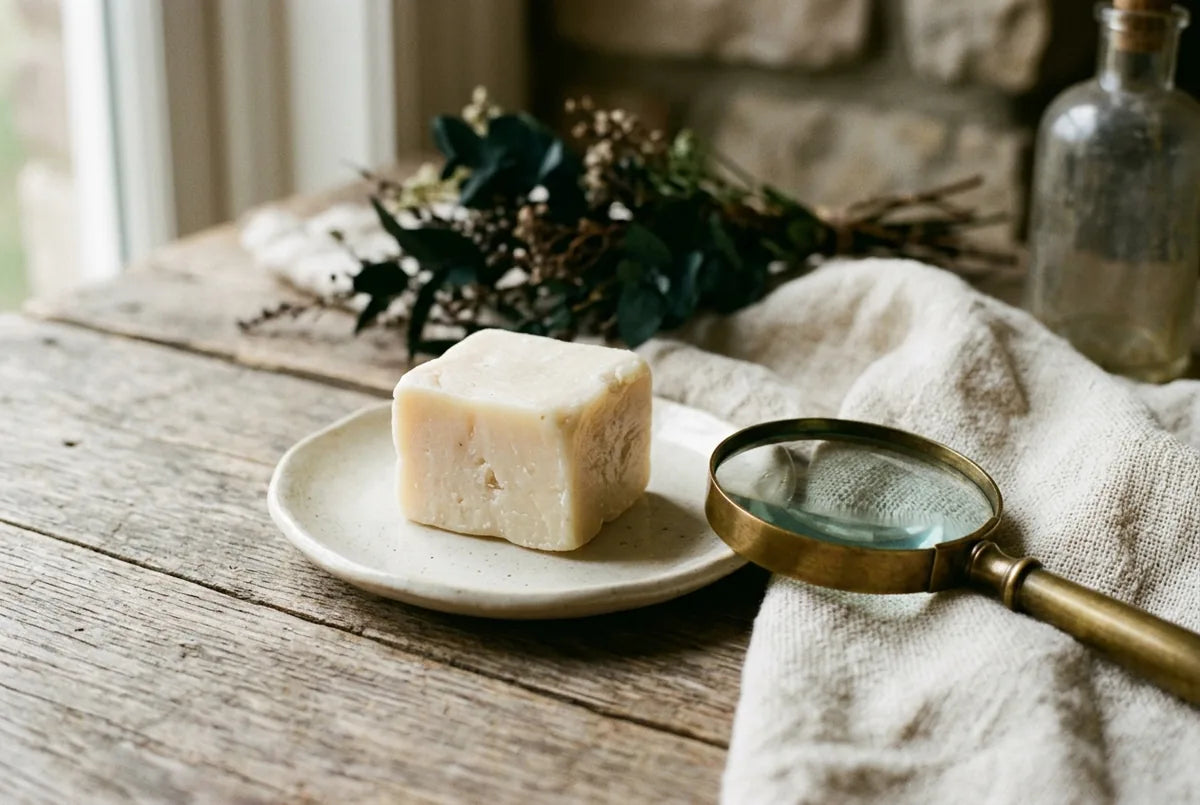
Spreading beef fat on your face: the idea is certainly surprising. And yet, beef tallow has become one of the most talked-about ingredients in natural skincare, and one question keeps coming up: is beef tallow comedogenic? Its proponents see it as a fatty substance close to human sebum; its detractors fear pimples and blackheads. The truth, as is often the case, lies somewhere in between—and it depends primarily on your skin. Here is the breakdown.
What is beef tallow? Definition and composition
Beef tallow (in English beef tallow, INCI name Adeps Bovis) is simply beef fat rendered at a low temperature, then filtered and purified. The result is a solid fat at room temperature, ivory in colour, and virtually odourless when well refined.
What makes it interesting in cosmetics is its composition: its fatty acids belong to the same families as the skin's natural lipids.[3]
| Fatty acid | Goes into the tallow | Skin function |
|---|---|---|
| Oleic acid | ≈ 36 to 43% | Penetration, flexibility |
| Palmitic acid | ≈ 23 to 27% | Natural component of sebum |
| Stearic acid | ≈ 15 to 23% | Texture, protection |
Added to this are fat-soluble vitamins (A, D, E, K) and, in the case of grass-fed beef, a naturally richer profile: the animal's diet directly influences the quality of its fat. This is why the origin—grass-fed cattle, a traceable source—changes everything.
This lipid profile, which is similar to sebum, is the main argument used by tallow advocates, and it is also the heart of the debate regarding its comedogenicity. For a complete overview of its benefits, we have detailed the subject in our article on the benefits of beef tallow for the skin.
Why is beef tallow applied to the skin?
The practice is nothing new. Long before the modern cosmetic industry, many cultures used animal fats to protect the skin against harsh climates: chapped hands, fissures, and skin damaged by the cold.
Its current comeback is due to three things: the demand for minimalist skincare with short ingredient lists, the enthusiasm for sustainable products (tallow upcycles a meat industry by-product, following a "nose-to-tail" philosophy), and, of course, the viral nature of social media. Cosmetically, a tallow balm performs three established functions: it nourishes, softens, and helps limit water loss by strengthening the skin barrier. Nothing miraculous — just a good fatty substance that does its job well.
The comedogenic scale: how it works (and its limitations)
Before deciding, you must understand the measurement tool. Comedogenicity refers to an ingredient's tendency to clog pores and promote the appearance of comedones (blackheads and whiteheads). It is traditionally rated from 0 (non-comedogenic) to 5 (highly comedogenic).[1]
The problem is that this scale is far from being an exact science. Many of these ratings come from old tests performed on rabbit ears, at concentrations unrelated to actual cosmetic use—a model whose validity has been seriously called into question by modern dermatology.[2] An ingredient can also behave very differently on its own or when integrated into a formula.
In other words, the comedogenic rating is an indicator, not a verdict. It provides a trend; your personal reaction will depend on your skin type, the quality of the product, and how you use it.
Is beef tallow comedogenic? A nuanced answer
Let's move on to the core question. Beef tallow is generally situated in the low to middle of the comedogenic scale. It is therefore neither an ingredient known to be "pore-clogging" like coconut oil, nor a completely neutral active ingredient.
The argument for tallow: its composition is similar to that of human sebum. In theory, the skin "recognises" these lipids and absorbs them rather than letting them sit on the surface. It is this mimicry that explains why many people with dry or normal skin use it daily without breakouts, resulting in more supple skin and a better-preserved skin barrier.[3]
The caution argument: tallow remains an occlusive and rich fatty substance. For oily or acne-prone skin, this dense texture can promote clogged pores. Its high oleic acid content, while an asset for absorption, is also the factor that can pose a problem for certain reactive or breakout-prone skin types.
Three variables make all the difference:
- Your skin type — dry and normal: low risk; oily and acne-prone: caution.
- Tallow quality — grass-fed, well-purified tallow feels lighter on the skin than poorly refined kitchen tallow.
- Quantity and frequency — a hazelnut-sized amount is enough; using too much is the most common mistake.
Beef tallow and acne: what you really need to know
This is the most sensitive point. If you have blemish-prone skin, tallow requires a methodical approach. People with active acne, easily clogged pores, or oily skin are at the highest risk, precisely because the skin already produces a lot of sebum and does not tolerate an additional oily layer well.
This does not mean an absolute "no": some combination skins can tolerate it if applied sparingly to targeted, dry areas only, at night, and in very small amounts. However, the approach must be cautious and gradual. If your primary concern is acne, it may be more relevant to explore other avenues; we discuss this in our guide on essential oils and blemish-prone skin.
An important note: beef tallow is a cosmetic product, not a treatment. It does not "cure" acne and is not a substitute for professional medical advice in cases of inflammatory or persistent acne.
What dermatologists say about it
The viral craze calls for a medical perspective, and it is a measured one. Dermatologists acknowledge that tallow is rich in fatty acids and vitamins capable of nourishing and strengthening the skin barrier, which can provide genuine relief to very dry skin.[4] At the same time, they point out two caveats: the risk of clogged pores for oily and acne-prone skin, and the fact that clinical research dedicated to cosmetic tallow remains in its infancy—most data focuses on its composition, and experts are calling for more controlled studies.[3]
The most consistent recommendation is simple and based on common sense: perform a patch test before any application on the face, and seek the advice of a dermatologist in case of doubt, particularly for reactive skin or in the event of an allergy to beef proteins.
Which skin types can use beef tallow?
| Skin type | Verdict | Advice |
|---|---|---|
| Dry to very dry | Ideal Profile | Suitable for daily use, low comedogenic risk |
| Normal | Well tolerated | Apply in the evening, small amount |
| Mature | Appreciated | Comfort and nutrition, without any miracle anti-ageing promises |
| Responsive / sensitive | Possible with caution | Systematic tolerance test, pure unscented tallow |
| Oily / acne-prone | Caution | Targeted and minimal application, or lighter emollient |
Reactive skin is a specific condition that we detail in our article beef tallow and rosacea.
Beef tallow or other fats: the comparison
Tallow is not the only fatty substance in the natural skincare aisle. To put it in context:
- vs coconut oil: coconut oil is known to be significantly more comedogenic. On this point, tallow is often better tolerated by blemish-prone skin.
- vs shea butter : two rich and nourishing fats; shea is plant-based and suitable for those who prefer to avoid animal products, while tallow stands out for its similarity to sebum.
- vs plant oils (jojoba…): lighter and quickly absorbed, they may suit oily skin better. Jojoba is one of the four core components in our formula, specifically to make the tallow lighter.
- vs honey and beeswax balms: more and more formulas are combining these ingredients. Honey brings its own properties—we’ve broken down what science has to say in our article honey on the skin.
The bottom line: no fat is universally "better." The right choice depends on your skin type and tolerance.
Precautions before applying tallow to the face
To maximise your chances of success and limit the risk of comedogenicity:
- Perform a patch test. Apply a small amount to the inside of the elbow or behind the ear for 24 to 48 hours before applying to the face.
- Start small and use at night. A pea-sized amount is sufficient. Applying it at night promotes absorption.
- Apply to clean, slightly damp skin. This helps the tallow absorb rather than sit on the surface.
- Use it as the final step. Tallow acts as a "sealant," after any serums or hydrolats you may use.
- Choose quality. Grass-fed tallow that is thoroughly purified (pale colour, almost neutral odour) and packaged away from light is less likely to clog the skin. This is the standard we set for our grass-fed beef tallow balm: traceable ingredients, artisanal purification, with no medical claims.
- Adapt it to your skin. If it is oily, reserve the tallow for dry areas and space out applications.
Is the TikTok trend justified?
What is justified: tallow is indeed a nourishing fatty substance, whose composition, similar to sebum, explains the many positive reviews from those with dry skin lacking comfort. The craze for simple, sustainable, and transparent skincare is a legitimate underlying trend.
What is exaggerated: videos that present tallow as a cure-all capable of fixing everything, from acne to wrinkles. A fatty substance is no substitute for a routine adapted to your skin type, nor for medical advice. And what works for a creator with dry skin won't necessarily work for oily skin.
The right approach is therefore neither rejection nor blind adoption: it is informed experimentation, using a quality product and a tolerance test.
A tallow purified to be light, not to be trendy
At ADEPSIA, the question of comedogenicity guided the formula: grass-fed tallow purified through successive thermal rinses, made lighter with jojoba oil — the liquid wax closest to sebum. Four core components, no water, nothing that overloads the skin.
A tiny amount is enough: it is also the best prevention against clogged pores.
View the ingredients of the Édition Logos balmThis article is for informational purposes only and does not constitute medical advice. Beef tallow is a cosmetic product: it does not treat any skin conditions. In case of inflammatory or persistent acne, or if in doubt, consult a dermatologist.
Frequently Asked Questions
Does beef tallow clog pores?
Does beef tallow cause acne?
Which skin types can safely use beef tallow?
Is beef tallow comedogenic for everyone?
What precautions should be taken before applying tallow to the face?
- Fulton J.E., Pay S.R., Fulton J.E. 3rd, "Comedogenicity of current therapeutic products, cosmetics, and ingredients in the rabbit ear", Journal of the American Academy of Dermatology, 1984.
- Draelos Z.D., DiNardo J.C., "A re-evaluation of the comedogenicity concept", Journal of the American Academy of Dermatology, 2006.
- Russell M.F. et al., « Tallow, Rendered Animal Fat, and Its Biocompatibility With Skin: A Scoping Review », Cureus, 2024.
- American Academy of Dermatology, communications and expert opinions on the "beef tallow skincare" trend, 2024-2025.