Find out why hands suffer in winter, the habits studied to protect them and the signs that mean you should see a doctor.
Journal · Body & care
Dry, chapped hands in winter: causes, habits and care
Do your hands feel tight, turn red and then crack as soon as the cold sets in? Dry air and repeated washing strip away the lipids that protect them.
The essentials in 30 seconds · TL;DR
- In winter, cold and dry air weaken the skin barrier. Repeated washing does the rest.
- The key habit: a cream or balm after every wash, on hands patted dry.
- Lukewarm or cold water cleans just as well as hot water, and irritates less.
- Gloves against the cold and for washing up, always put on over dry hands.
- Cracks that bleed, itching or small blisters: see a doctor.
Why do hands suffer in winter?
In short: cold and dry air weaken the skin barrier, and hands also have to cope with repeated washing.
The surface of the skin holds together thanks to lipids that bind its cells and retain water. A 2016 review concludes that low temperatures and low humidity reduce this barrier function. The skin also becomes more reactive to irritants. The mechanism is the same as for very dry skin on the rest of the body.
Hands start at a disadvantage. They stay exposed when the rest of the body is covered, and the palm has no sebaceous glands. On top of that come everyday aggressions:
- Dry cold: it weakens the barrier of exposed skin.
- Heating: it dries out indoor air.
- Repeated washing: soaps and detergents remove part of the surface lipids.
- Hot water: above 40 °C, it disorganises these lipids.
- Household products: detergents and disinfectants are known irritants.
The imbalance often comes from this: we wash a lot and protect little. During the Covid-19 epidemic in China, 66.1% of healthcare workers washed their hands more than ten times a day. Only 22.1% applied a moisturiser afterwards.
Dry hands, chapping, cracks: what is the difference?
In short: they are three stages of the same dryness, from simple tightness to a deep fissure.
| Dry hands | Chapping | Cracks | |
|---|---|---|---|
| What you see | rough, dull skin, fine flakes | small surface fissures, redness | deep fissures, sometimes bleeding |
| What you feel | tightness | tingling, burning on contact with water | pain at the slightest movement |
| What is needed | a rich moisturiser after every wash | a richer product, gloves, an evening treatment | advice from a pharmacist or doctor |
The earlier you act, the simpler it is. Cracked skin lets irritants through and takes time to close up again.
Dry hands in winter: 6 habits that protect
1. Wash with lukewarm or cold water
Water temperature makes no difference to the removal of microbes. In a study of 10 volunteers, the same detergent irritated the skin more at 40 °C than at 20 °C or 4 °C.
Expected result: less redness and tightness after washing.
2. Choose a gentle cleanser
Alkaline soaps disturb the skin’s natural acidity. “Soap-free” bars and gels have a pH of 5.5 to 7, close to that of the skin. Choose fragrance-free ones.
Expected result: fewer lipids removed with each wash.
3. Pat dry
Rubbing with a rough towel or paper adds mechanical aggression. Pat dry, not forgetting the spaces between the fingers.
Expected result: less irritated skin, ready for moisturiser.
4. Apply a moisturiser after every wash
This is the best-documented habit. In one study, 25 volunteers washed their hands and forearms four times a day for two weeks. Without cream, hydration measured on the forearm fell from 79 to 65.5. With a cream after each wash, it stayed at 75.6.
American dermatologists specialising in contact dermatitis advise reapplying moisturiser every three to four hours, or after each wash. For a cream, their guide is two “fingertip units” per hand: two lines of cream the length of the last joint of the index finger.
Expected result: skin that stays supple despite washing.
5. Wear gloves, over dry hands
Warm gloves outdoors, household gloves for washing up. Always put them on over clean, thoroughly dry hands. Under a glove, traces of soap or detergent irritate considerably more.
Expected result: less contact with cold, water and products.
6. Do an evening treatment
When hands are very dry, soak them for twenty minutes in plain water. Apply your moisturiser straight away to the still-damp skin. Repeat this ritual every evening, for two weeks at most. Cotton gloves keep the sheets clean.
Expected result: more supple hands on waking.
A humidifier in the bedroom also helps when heating dries out the air. Clean it regularly to prevent mould.
Cream, balm or petroleum jelly: which care for hands?
In short: the greasier the texture, the more it protects. Ointments come first, ahead of creams, lotions and then gels.
| Family | Examples | What it does |
|---|---|---|
| Humectants | glycerine, urea | attract water into the surface layer |
| Emollients | plant oils, jojoba, shea, tallow | soften and fill the spaces between cells |
| Occlusives | petroleum jelly, beeswax | form a film that limits water evaporation |
The best-studied reference remains petroleum jelly. The American Academy of Dermatology recommends fragrance-free products based on petroleum jelly or mineral oil, which it considers the most effective and the least allergenic. In a 1992 study, petroleum jelly even accelerated the recovery of a damaged skin barrier. We compare the two in beef tallow or petroleum jelly.
Butters and fats of natural origin are less studied. They belong to the same family of fats, as shown in our comparison of tallow and shea butter.
Two precautions before choosing:
- Fragrance: on irritated hands, choose a fragrance-free product. Fragrances and preservatives are among the allergens most often found in hand products.
- Latex gloves: fats weaken latex and rubber. Do not apply balm or petroleum jelly just before wearing them.
Is beef tallow suitable for dry hands?
In short: it is an emollient fat that has long been used, but no controlled trial has tested it on dry hands.
Tallow is beef fat, rendered and then purified. We detail its composition in what is beef tallow.
A review published in 2024 screened 147 studies and retained 19. It concludes that there are significant gaps regarding the use of tallow on human skin. On side effects, the sources contradict each other. The authors call for controlled trials.
Its value for hands therefore lies in its nature as a fat. No clinical evidence places it above a rich cream or petroleum jelly.
What about the ADEPSIA Balm?
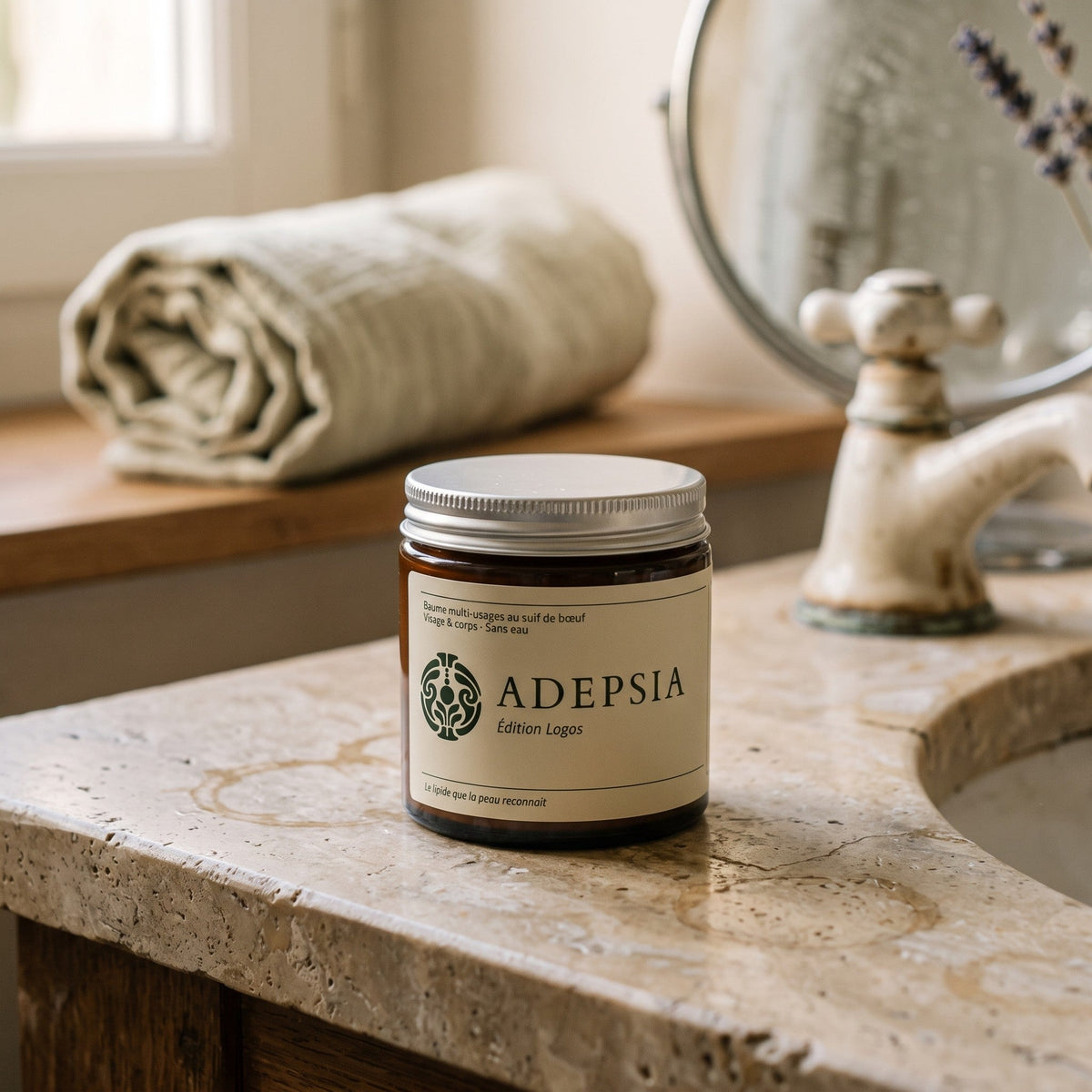
The ADEPSIA Balm has no added water. It combines tallow with beeswax, an occlusive, jojoba, which the American Academy of Dermatology lists among the ingredients helpful for dry skin, and honey, a humectant. Vitamin E protects the formula from going rancid.
It also contains a note of ylang-ylang, and therefore a fragrance. On chapped, cracked or eczema-prone hands, choose a fragrance-free product, or test it first on a small area. No clinical study has been carried out on the balm itself.
For the amount, see how to apply it. Always take it with thoroughly dry fingers: that is the rule for keeping a water-free balm. To go further, read our guide to beef tallow.
When should you see a doctor?
In short: when fissures are deep, when other signs appear or when nothing improves.
Seek medical advice if:
- cracks bleed or do not close up;
- your hands itch intensely, with red patches or small blisters;
- the skin oozes, forms crusts or becomes hot and increasingly painful;
- the dryness persists despite regular care;
- your job exposes your hands every day: hairdressing, healthcare, cleaning, construction, food.
Red, itchy hands can be a sign of eczema. The French national health insurance distinguishes contact eczema, which is an allergy to a substance, from irritant dermatitis, caused by physical or chemical aggression. Hand eczema is a common inflammatory disease, covered by European guidelines. A cosmetic product does not treat it.
Frequently asked questions
Why are my hands drier in winter?
Cold and dry air reduce the skin’s barrier function. Hands, uncovered and washed often, lose their lipids faster than the rest of the body.
What is the difference between chapping and a crack?
Chapping is a superficial fissure. A crack is deeper, painful and may bleed: it warrants advice from a pharmacist or doctor.
Does hand sanitiser damage the hands?
Less than people think. According to the American Contact Dermatitis Society, sanitisers enriched with moisturisers irritate less than soaps. Choose fragrance-free ones. When hands are visibly dirty, washing with soap and water remains necessary.
What home remedy for chapped hands?
A lukewarm water soak followed by a fat, under cotton gloves overnight. Avoid lemon and bicarbonate of soda, which irritate. See also honey on the skin.
Should you apply cream after every hand wash?
Yes, it is the best-studied habit. In a study of 25 volunteers, a cream applied after each wash limited skin dryness and roughness.
Key points to remember
For dry hands in winter, regularity matters more than the product: lukewarm water, gentle drying, a rich moisturiser after every wash, gloves outdoors and for washing up. These habits are often enough. If not, talk to a doctor.
At ADEPSIA, we favour ingredients whose function is clearly identified, without attributing to a product clinical effects that have not been demonstrated.
Scientific and medical references
Bibliographic references, without active external links. Sources consulted on 13 November 2026.
1. Engebretsen K. A. et al. (2016)
The effect of environmental humidity and temperature on skin barrier function and dermatitis. Journal of the European Academy of Dermatology and Venereology. PMID 26449379. DOI 10.1111/jdv.13301.
Review: effect of cold and dry air on the skin barrier.
2. Rundle C. W. et al. (2020)
Hand hygiene during COVID-19: Recommendations from the American Contact Dermatitis Society. Journal of the American Academy of Dermatology. PMID 32707253. DOI 10.1016/j.jaad.2020.07.057.
Recommendations: water temperature, drying, frequency and amount of moisturiser, gloves, hand sanitisers.
3. Kampf G., Ennen J. (2006)
Regular use of a hand cream can attenuate skin dryness and roughness caused by frequent hand washing. BMC Dermatology. PMID 16476166. DOI 10.1186/1471-5945-6-1.
Crossover study in 25 volunteers, two weeks, measurements on the forearm.
4. Berardesca E. et al. (1995)
Effects of water temperature on surfactant-induced skin irritation. Contact Dermatitis. PMID 7758326. DOI 10.1111/j.1600-0536.1995.tb00751.x.
Study in 10 volunteers: a detergent irritates more at 40 °C.
5. Tiedemann D. et al. (2016)
Effect of glove occlusion on the skin barrier. Contact Dermatitis. PMID 26364588. DOI 10.1111/cod.12470.
Review of 13 studies: wearing gloves worsens the effect of detergents left on the skin.
6. Ghadially R. et al. (1992)
Effects of petrolatum on stratum corneum structure and function. Journal of the American Academy of Dermatology. PMID 1564142. DOI 10.1016/0190-9622(92)70060-s.
Study in volunteers: petroleum jelly accelerates barrier recovery.
7. Thyssen J. P. et al. (2022)
Guidelines for diagnosis, prevention, and treatment of hand eczema. Contact Dermatitis. PMID 34971008. DOI 10.1111/cod.14035.
Guidelines of the European Society of Contact Dermatitis.
8. Russell M. F. et al. (2024)
Tallow, Rendered Animal Fat, and Its Biocompatibility With Skin: A Scoping Review. Cureus. PMID 38910727. DOI 10.7759/cureus.60981.
Review of research on tallow; limits of the evidence on human skin.
9. American Academy of Dermatology
Dermatologists’ top tips for relieving dry skin.
Rich textures, moisturiser after every hand wash, gloves, humidifier.
10. ameli.fr, Assurance Maladie (2026)
Eczéma de contact : causes, symptômes et évolution.
Signs of contact eczema and how it differs from irritant dermatitis.
This article is for information only and does not replace a medical consultation. The studies cited do not constitute evidence of the clinical efficacy of the ADEPSIA Balm.