Acne in two words: sebum, pimples and blackheads
Acne is primarily a matter of sebum. When the skin produces too much, sebum accumulates in the pores along with dead skin cells. The pore becomes clogged, leading to the formation of a blackhead or a microcyst.
Add a bacterium naturally present on the skin, Cutibacterium acnes, and a little inflammation: the red pimple appears. It is this trio—excess sebum, clogged pore, and inflammation—that explains most imperfections of acne-prone skin.
Understanding this is already knowing where to take action. A good routine seeks to soothe inflammation, limit bacterial proliferation, and regulate sebum without stripping the skin. And that is exactly where certain essential oils come into play.
Why essential oils speak to blemish-prone skin
An essential oil is the concentrated essence of a plant. A few drops are enough, as the substance is very potent. Several of them have properties that are directly beneficial for acne-prone skin.
Three families of properties are often identified: antibacterial, to limit the bacteria involved in acne; anti-inflammatory, to soothe redness and breakouts; and purifying or astringent, to help refine skin texture.
Be careful, however, not to oversell. These properties are real, but the level of evidence varies greatly from one oil to another. Only one truly has a consensus in research: tea tree.
The best essential oils for acne
Tea tree, the most studied
Tea tree essential oil (Melaleuca alternifolia) is the star of blemish-prone skin, and it’s not just a trend. A clinical study compared a 5% tea tree gel to a placebo in 60 people: over 45 days, the gel proved to be approximately 3.5 times more effective on the number of lesions and nearly 5.7 times more effective on the severity of acne. It is a serious reference for an essential oil.
It is used as a spot treatment on the blemish, always diluted. It is the one oil to know if you only had to choose one.
Lavender (true and spike), the soothing one
True lavender is known for its soothing and restorative properties, which are useful when skin is irritated by breakouts. Spike lavender, which is more invigorating, is often cited for small, localized blemishes. Clinical evidence regarding acne remains limited, but lavender has the advantage of being gentle and well-tolerated by many skin types.
Rose geranium, the balancer
Rose geranium is prized for its reputed balancing action on sebum and its purifying properties. It blends well with tea tree and lavender in a synergy. Here again, this is based on traditional and cosmetic use rather than solid clinical evidence.
Vegetable oil, the essential ally (and jojoba)
Here is the point that is too often forgotten: an essential oil is almost never applied on its own. It is diluted in a vegetable oil, which serves as a carrier and protection for the skin. And the choice of this vegetable oil matters just as much as that of the essential oil.
For blemish-prone skin, jojoba is a go-to choice. Its unique feature is invaluable: its composition closely resembles human sebum. The skin recognises it, which helps regulate sebum production rather than weighing it down. It is also known to be non-comedogenic, meaning it does not clog pores. Jojoba shares this similarity to sebum with other lipids: this is also what explains the benefits of beef tallow for dry skin.
It’s not just theory. In a study of 133 people with skin lesions and mild acne, applying a clay mask containing jojoba oil two to three times a week was associated with an average reduction of approximately 54% in the number of lesions after 6 weeks.
It is precisely for these qualities that we chose jojoba as one of the ingredients for our jojoba and tallow balm. To learn more about this ingredient, see our dedicated page: jojoba gold.
How to use essential oils safely
Safety is not a detail when dealing with such concentrated substances. A few simple rules are enough to avoid most problems.
First, dilute it. For the face, keep the essential oil concentration around 1 to 2% in the carrier oil, which is about 1 to 2 drops of essential oil per teaspoon of jojoba oil. Next, test it: apply a small amount to the inside of the elbow for 48 hours to ensure the skin tolerates it. Finally, apply it locally to the blemish in the evening on clean skin, without rubbing.
And you should never apply a pure essential oil to your face as part of your routine: the risk of irritation and sensitization is too high, especially on skin already weakened by acne.
A simple synergy to prepare at home
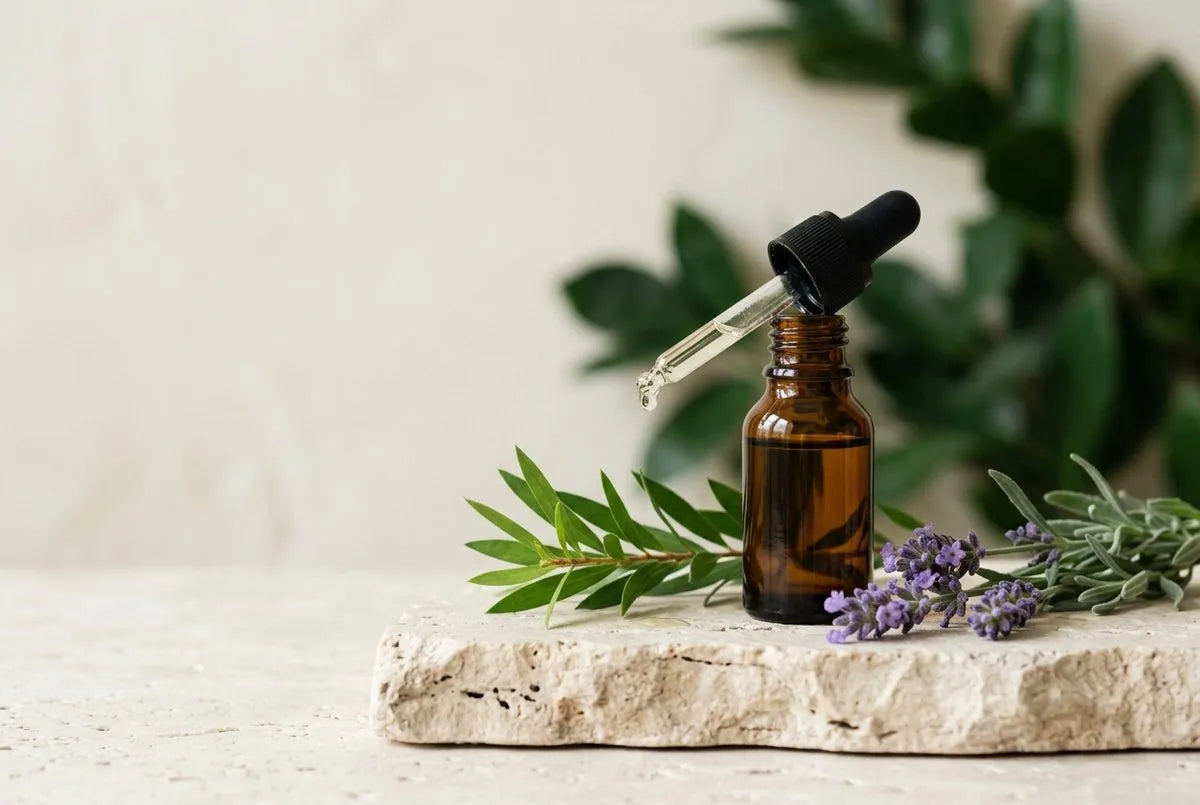
If you would like to test it, here is a gentle, classic synergy for blemish-prone skin, to be prepared in a small tinted glass bottle:
Measure out 30 ml of jojoba vegetable oil as a base. Add 6 drops of tea tree, 4 drops of true lavender, and 2 drops of rose geranium. This remains under the 2% threshold and is suitable for evening topical use. Close tightly, store away from light, and perform a skin patch test before the first application.
This synergy is a comfort care product, not a treatment. If the acne is severe, it is better to consult a dermatologist before experimenting.
How long until I see results?
Patience is part of the protocol. The skin renews itself over several weeks, and no oil changes skin texture overnight. Available studies, on both tea tree and jojoba-based treatments, measure their effects after 4 to 6 weeks of regular use.
Give your routine some time, while remaining attentive to any reactions. If nothing changes after six to eight weeks, or if your skin condition worsens, it is a sign to make adjustments or seek advice.
Precautions to know
Essential oils are powerful, and powerful means to be handled with respect.
Some, particularly citrus fruits, are photosensitizing: avoid the sun in the hours following application. Pregnancy, breastfeeding, and young age require great caution, if not total abstention, and professional advice. Very reactive skin, such as skin prone to rosacea, may not tolerate these substances, including fragrances and aromatic molecules. And above all, cystic or severe acne is not a matter for essential oils: it must be managed with a dermatologist.
In short, essential oils can support skin with mild to moderate blemishes, but they should never replace medical treatment when it is necessary.
A material that the skin recognises
At ADEPSIA, we believe in short, readable formulas. That is why we chose jojoba: a botanical oil similar to human sebum, ideal as a base for acne-prone skin. The foundation before the promises.
We also believe in honesty. A well-used essential oil can help, but it must be diluted, tested, and take a backseat to a dermatologist's advice as soon as acne becomes serious. Good skincare begins with knowing if it is right for you.
Discover the beef tallow balm and join the waiting listKey takeaways
Essential oils can be true allies for blemish-prone skin, provided they are used methodically. Tea tree is the best documented, while lavender and rose geranium provide comfort and soothing. Always dilute them in a botanical oil, and jojoba, which is similar to sebum and non-comedogenic, is an excellent choice for acne-prone skin. Dilute, test, apply locally in the evening, be patient over several weeks, and entrust severe acne to a dermatologist.
This article is informative and is not a substitute for medical advice. Moderate to severe acne, especially cystic acne, should be managed by a dermatologist.
Frequently Asked Questions
What are the best essential oils for acne?
How to use essential oils safely?
How long does it take to see results?
Can you apply a pure essential oil to a pimple?
Are essential oils suitable for cystic acne?
- Enshaieh S., Jooya A., Siadat A.H., Iraji F., « The efficacy of 5% topical tea tree oil gel in mild to moderate acne vulgaris : a randomized, double-blind placebo-controlled study », Indian Journal of Dermatology, Venereology and Leprology, 2007;73(1):22-5. https://pubmed.ncbi.nlm.nih.gov/17314442/
- Meier L., Stange R., Michalsen A., Uehleke B., « Clay jojoba oil facial mask for lesioned skin and mild acne », Forschende Komplementärmedizin, 2012;19(2):75-9. https://pubmed.ncbi.nlm.nih.gov/22585103/
- « Efficacy and safety of Melaleuca alternifolia (tea tree) oil for human health — A systematic review of randomized controlled trials », 2023. https://www.ncbi.nlm.nih.gov/pmc/articles/PMC10080088/