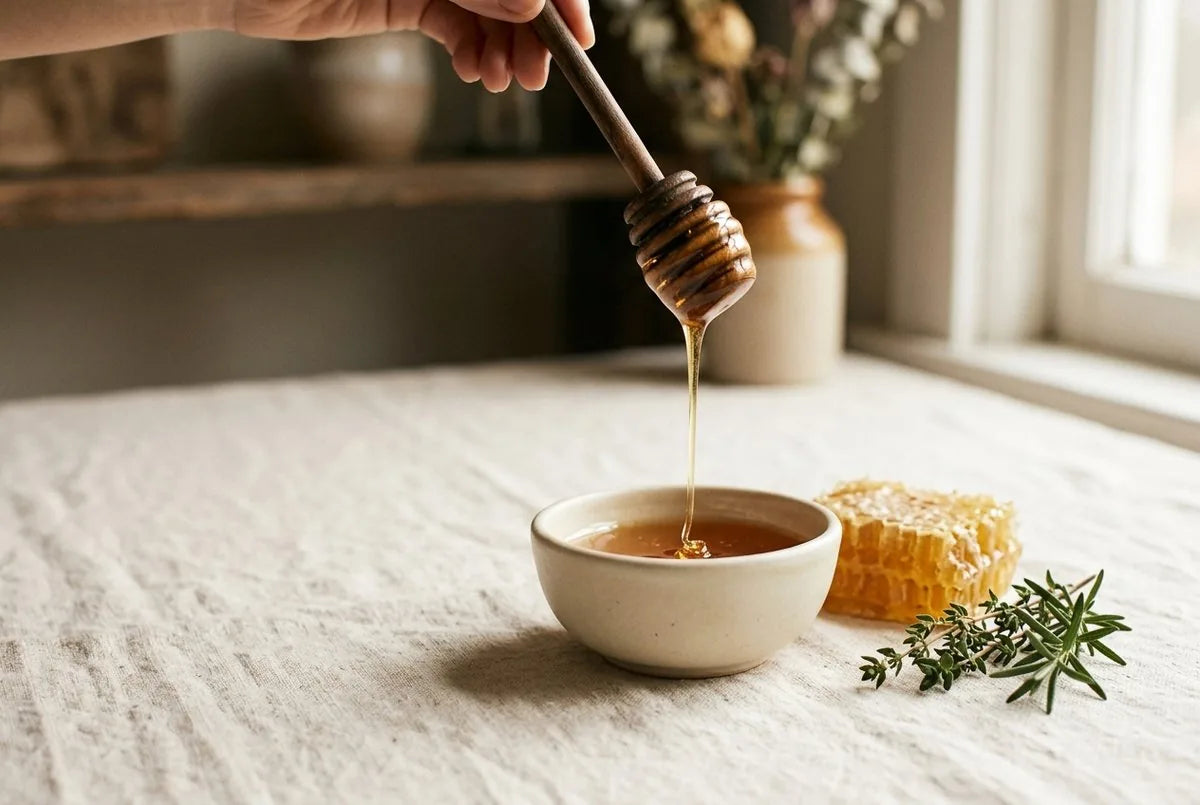
There is a good chance that, somewhere in your kitchen, one of the world's oldest beauty treatments is hiding. Not in an overpriced bottle, not in a cream with endless promises: in a simple jar of honey. Traces of its use on the skin can be found as far back as the earliest civilisations—the Egyptians used it as an ointment, and the traditional medicine of many peoples used it to dress, soothe, and nourish. It was not a trend. It was knowledge.
The good news is that modern science hasn't just shrugged its shoulders at this tradition. It has examined it. And what it found is, frankly speaking, quite impressive. This article provides a comprehensive overview of the issue, without any exaggerated promises.
Why honey and skin get along so well
To understand what makes honey interesting, you have to look at what it contains. Far from being just "liquid sugar," honey is a rich and complex solution, composed primarily of fructose and glucose, but also of proteins, amino acids, vitamins, enzymes, minerals, and antioxidant plant compounds.[6] It is precisely this cocktail that gives it its benefits for the skin.
What research really highlights
1. A natural moisturiser that works deep down
Honey is what is known as a humectant: a substance that attracts water and retains it. Thanks to its composition, which is rich in sugars and amino acids, it captures moisture from the air and fixes it into the superficial layers of the skin. The result is skin that is visibly more supple, smoother, and better plumped.[1] Furthermore, the free amino acids it contains belong to the same family of molecules as those in our skin's natural moisturising factor—which is to say, it speaks the same language as the skin.
2. An ally against bacteria and blemishes
It is arguably the most studied property. Honey possesses real antibacterial activity, which is explained by several combined mechanisms: its acidity, its osmotic effect (it literally "dries out" bacteria), its gradual release of hydrogen peroxide, and, for certain honeys such as manuka, the presence of methylglyoxal.[4] Laboratory studies have shown that honeys from all over the world possess antimicrobial activity against common skin microbes. It is this quality that makes it interesting for acne-prone skin and blemishes.
3. A soothing product for reactive skin
Honey also has anti-inflammatory properties. It helps soothe redness and feelings of discomfort, which explains its traditional appeal for reactive or irritated skin. Several scientific reviews have explored its role in supporting various skin conditions, from dermatitis to psoriasis, although the level of evidence varies depending on the condition.[2]
4. Support for healing and repair
Honey has been used for a very long time to aid healing, particularly for superficial burns. Clinical research has shown encouraging results in the healing of partial-thickness burns, whereas evidence remains more mixed for other types of wounds.[5] From a cosmetic perspective, its ability to support epidermal renewal and promote healthier-looking skin is what stands out most.
5. A radiance-boosting and anti-ageing effect
Rich in antioxidants—notably phenolic compounds and flavonoids—honey helps protect the skin from oxidative stress, one of the factors of skin ageing. Interestingly, dark honeys are generally richer in antioxidants than light honeys.[6] Reviews in cosmetic dermatology acknowledge its softening effect, its support for elasticity, and even its contribution to delaying the appearance of wrinkles.[1] Nothing magical, but a true long-term routine companion.
| Benefit | Mechanism | Level of evidence |
|---|---|---|
| Hydration | Humectant effect of sugars and amino acids | Strong |
| Antibacterial action | Acidity, osmosis, hydrogen peroxide, methylglyoxal | Strong (in vitro) |
| Soothing | Anti-inflammatory properties | Moderate |
| Wound healing | Support for epidermal renewal | Good for superficial burns |
| Anti-ageing protection | Antioxidants (phenols, flavonoids) | Emerging |
Honey according to your skin type
A common question is: is honey suitable for all skin types? Overall, its gentleness makes it a well-tolerated ingredient, but every skin has its own specific needs. Here are a few guidelines to help you.
| Skin type | Why honey helps | Precaution |
|---|---|---|
| Dry, dehydrated | Its moisturising power comforts skin that feels tight and lacks suppleness. That is where it shines the most. | Rinse well to avoid a sticky film. |
| Combination to oily, acne-prone | The antibacterial action helps to sanitize without being harsh. | Use for a short time, then rinse off thoroughly. |
| Sensitive, responsive | The soothing properties calm redness. | Patch test on the inside of the elbow is mandatory before applying to the face. |
| Mature | Antioxidant effect and comfort, supporting radiance and suppleness. | Integrate into a regular routine. |
How to use honey: face, body, and hair
The best thing about honey is its simplicity. There is no need for a complicated protocol to get the most out of it, and its uses go far beyond just the face.
- As a face mask, it's the simplest method. Apply a thin layer of honey to clean, slightly damp skin, leave it on for about fifteen minutes, then rinse with warm water.
- As a gentle cleanser. Massage a small dollop of honey onto damp skin in circular motions, then rinse. It cleanses without stripping.
- For targeted care. On an isolated blemish, a tiny dab of honey left on for a few minutes can help thanks to its antibacterial action.
- On hair. As a hair mask, mixed with a little oil, it adds softness and shine to dry lengths. Naturally nourishing care for more supple hair.
Application tip: honey is generally used at 1 to 10% in cosmetic formulas, but in homemade skincare, it is its raw concentration that acts. Choose raw, unpasteurised honey, which better preserves its enzymes and active ingredients—pasteurization, by heating the honey, reduces some of its properties.
Five simple and effective homemade recipes
Honey is wonderful for homemade preparations: on its own, it already works wonders, but when combined with a few everyday ingredients, it reveals other facets. Use them fresh, on clean skin, and always perform a patch test in the crook of your elbow beforehand.
| Recipe | Ingredients | Leave-on time |
|---|---|---|
| Quick hydrating mask | 1 tsp raw honey | 15 min |
| Gentle honey & oat scrub | 1 tbsp honey + 1 tsp ground oats | Massage |
| Honey & yoghurt radiance mask | 1 tsp honey + 1 tbsp plain yoghurt | 10–15 min |
| Honey & coffee toning scrub | 1 tbsp honey + 1 tsp coffee grounds | Massage |
| Clarifying honey & lemon mask | 1 tsp honey + a few drops of lemon | 10 min (evening) |
The instant hydrating mask
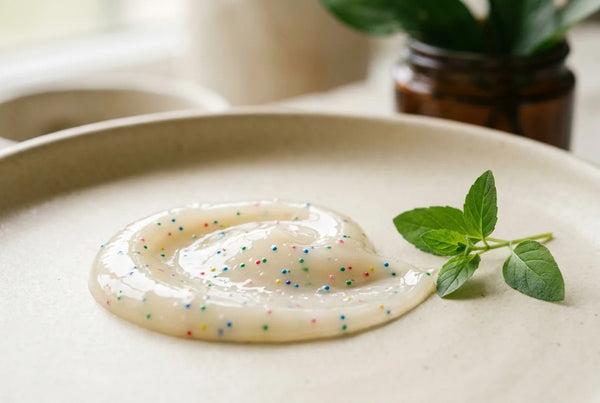
The most basic, and often the most effective. A teaspoon of raw honey, spread in a thin layer over the face. Leave on for 15 minutes, then rinse with warm water. Ideal for restoring comfort to tight-feeling skin.
Honey and oatmeal gentle scrub
Mix one tablespoon of honey with one teaspoon of finely ground oats. Gently massage in circular motions to exfoliate, then rinse. The oats soothe while the honey hydrates.
Honey and yoghurt radiance mask
A teaspoon of honey mixed with a tablespoon of plain yoghurt. This combination provides softness and freshness, perfect for a quick glow before an evening out. Leave on for 10 to 15 minutes, then rinse.
Honey and coffee toning scrub
If you keep your morning coffee grounds, here is how to recycle them: mix one teaspoon of grounds with one tablespoon of honey. The coffee, also rich in antioxidants, provides invigorating exfoliation while the honey nourishes. Massage in circular motions, ideally on the body, then rinse.
The honey and lemon purifying mask (use with caution)
For blemish-prone skin, a few drops of lemon juice added to a teaspoon of honey enhance the purifying effect. A word of caution, however: lemon is photosensitizing. Reserve this recipe for the evening, do not exceed 10 minutes of application, and avoid any sun exposure afterward. Avoid on sensitive skin.
Precautions and contraindications: read before starting
Honey is a gentle ingredient, but “natural” does not mean “risk-free” for everyone. A few precautions are needed.
The risk of allergy
This is the number one precaution. People allergic to pollen, bee venom, or hive products may react to honey applied to the skin. Before any first use, perform a skin patch test: apply a small amount to the inside of the elbow and wait 24 to 48 hours. If there is no redness, itching, or swelling, you can use it more widely.
In case of reaction
Redness, persistent stinging, itching: rinse immediately and discontinue use. If symptoms persist, consult a healthcare professional.
On wounds and established conditions
While the traditional use of honey on minor wounds is documented, home remedies do not replace medical advice. For a wound that won't heal, a chronic skin condition, or problem skin, consult a dermatologist. Also note: medical-grade honey used in hospitals is sterilised and standardised, which is not the case for the honey in your kitchen.
Proper rinsing
Honey is sticky and stays on the surface: be sure to rinse well to avoid a film-like feeling on the skin.
Can honey replace your standard cosmetic products?
That is a legitimate question, and the honest answer is: in part, but not for everything. Honey is an excellent natural supplement to a routine — a weekly mask, a gentle cleanser, or an occasional radiance booster. It can advantageously replace certain store-bought moisturising masks or scrubs.
However, honey does not do everything. It does not protect against the sun, and diet does not replace sun protection, as discussed in our guide to tanning without sunscreen. It does not replace a skincare cream formulated to stay on the skin, either, and its stickiness makes it better suited to rinse-off care. The wisest approach is to bring honey into your routine where it works best, while keeping the rest of the routine consistent.
This is the philosophy we value at ADEPSIA: returning to the natural ingredients our ancestors used sensibly, because they work, without taking an all-or-nothing approach. Honey, like beef tallow and beeswax, has a place in a simple, sincere approach to skincare. That approach also informs our beef tallow balm.
Frequently Asked Questions
Is honey suitable for all skin types?
Which honey should I choose for my skin?
Can you apply honey to your face every day?
Does honey really help with acne?
Is honey effective against wrinkles?
How long should I leave a honey mask on?
- Burlando B., Cornara L. "Honey in dermatology and skin care: a review." Journal of Cosmetic Dermatology, 2013;12(4):306-313. https://doi.org/10.1111/jocd.12058
- Jodidio M. et al. "Honey therapies for dermatological disorders: more than just a sweet elixir." International Journal of Dermatology, 2024;63(4):422-430. https://doi.org/10.1111/ijd.16925
- McLoone P. et al. "Honey: A Therapeutic Agent for Disorders of the Skin." Central Asian Journal of Global Health, 2016 (PMC5661189). https://pmc.ncbi.nlm.nih.gov/articles/PMC5661189/
- Yaghoobi R. et al. "Evidence for Clinical Use of Honey in Wound Healing as an Anti-bacterial, Anti-inflammatory Anti-oxidant and Anti-viral Agent: A Review." The Scientific World Journal (PMID 24624197). https://pubmed.ncbi.nlm.nih.gov/24624197/
- Molan P., Rhodes T. "Honey and Wound Healing." American Journal of Clinical Dermatology, 2012. https://doi.org/10.2165/11538930
- Cianciosi D. et al. « Phenolic Compounds in Honey and Their Associated Health Benefits: A Review. » Molecules, 2018;23(9):2322. https://doi.org/10.3390/molecules23092322
This article is provided for informational purposes only and does not constitute medical advice. Honey is a cosmetic product, not a treatment. In the event of an allergy to hive products, a skin condition, or a wound that does not heal, consult a healthcare professional.